Why Energy Inequities Could Persist in the Clean Energy Transition
A live discussion with Sanya Carley and David Konisky, authors of the new book Power Lines, on the inequities that define America’s energy system—and how they could carry into the clean energy future if left unacknowledged.
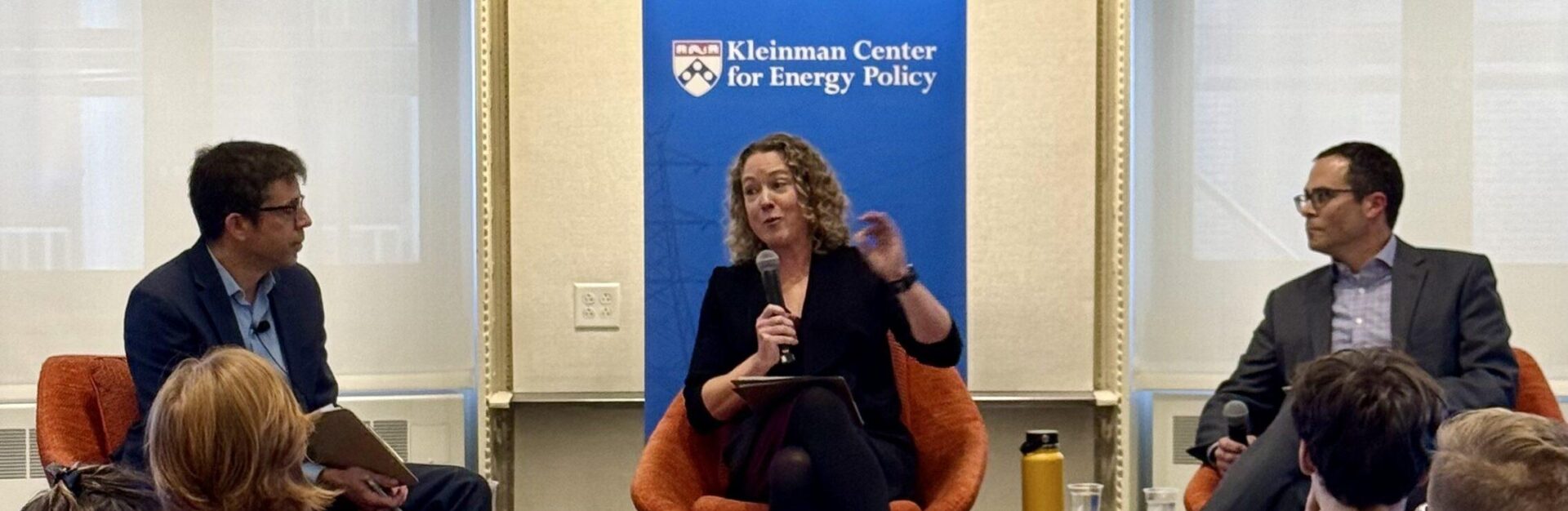
In this special live episode of Energy Policy Now, recorded before an audience during Climate Week at the University of Pennsylvania, guests Sanya Carley and David Konisky discuss their new book Power Lines: The Human Costs of American Energy in Transition. The book explores how America’s energy system both reflects and reinforces deep social and economic divides, and why a cleaner grid won’t automatically lead to a fairer one.
Drawing on a decade of research and stories from communities on the front lines of the energy transition, Carley and Konisky show that before the nation can make progress toward energy justice, it must first recognize the people and places most affected by the inequities built into the system. Power Lines explores how those inequities shape lives and communities across the United States.
Sanya Carley is the Mark Alan Hughes Faculty Director of the Kleinman Center and Presidential Distinguished Professor of Energy Policy and City Planning at the Stuart Weitzman School of Design. David Konisky is the Associate Dean for Research and a Lynton K. Caldwell Professor at the Paul H. O’Neill School of Public and Environmental Affairs at Indiana University. Together, they co-direct the Energy Justice Lab.
Recorded live at the Kleinman Center for Energy Policy during Penn’s Climate Week.
Andy Stone: Welcome to the Energy Policy Now podcast from the Kleinman Center for Energy Policy at the University of Pennsylvania. I’m Andy Stone. Today’s episode of Energy Policy Now is a very special one. It was recorded in front of a live audience in the Forum at the Kleinman Center on October the 14th during climate week on the Penn campus. The topic of our discussion is a newly published book on energy justice in the United States titled Power Lines: The Human Costs of American Energy in Transition.
Our conversation is with the two authors of the new book, which itself is the culmination of a decade of research into the equity challenges inherent in our energy system. The book chronicles those challenges and explains why they are likely to persist in the transition to a cleaner energy economy if not acknowledged and addressed purposefully. Our guests are Sanya Carley, Faculty Director of the Climate Center for Energy Policy, and David Konisky, Associate Dean for Research in the School of Public Affairs at Indiana University. And here’s our conversation followed by Q&A with the audience.
The book starts from a simple but powerful idea that the energy system isn’t just wires and power plants. It is, in fact, part of the fabric of our daily lives, and for millions of Americans, that fabric looks very different depending on where they live and the resources that they have access to. Power Lines traces those differences in the benefits and costs of our energy system across geography, income, and social identity. The book is the culmination of a decade of research, including interviews and focus groups with people living on the front lines of our energy system. These are the people who feel its benefits and its costs most acutely.
But the book goes beyond documenting the challenges of energy, justice and injustice today. It paints a broad portrait of our energy system itself, including its physical infrastructure and the social systems that support it, to show how these elements will continue to shape the lives and communities well into the future, regardless of and despite of the type of fuel and energy we’re talking about. And at its core, Power Lines makes a very powerful argument, that a cleaner energy system is not automatically a more just one. As Sanya and David write, justice isn’t an outcome to be assumed, it’s a decision that we have to make.
The book arrives at a tumultuous moment for American energy. The strong clean energy push of the Inflation Reduction Act and the energy justice provisions that it contained are now being rolled back by an administration that has very different priorities. The pace of the transition may slow as a result, but it will not stop, and the chance to make that transition fairer and more inclusive still stands, and I would say, is even more urgent now than before. And Sanya and David, it is a pleasure to have you both here.
David Konisky: Thanks for having us.
Stone: We’re going to be talking about your new book, Power Lines, which was published just yesterday, October the 13th. And first off, congratulations is due. This book is a encompassing and eye opening look at energy injustice in this country. And I have to say, beyond that, for all of you who picked up the book out front, it is a great read, okay? I am a very, very slow reader, but this one pulled me through. So really great job in the writing as well. But getting to the point of our conversation here today.
The book is a culmination of a full decade of research by the two of you, okay, into the clean energy transition and its implications for communities and this country more broadly. And energy justice has been a growing element of the national conversation, most notably in recent years, and I think that the clearest evidence of that was the Inflation Reduction Act, which became law in 2022, as well as the justice provisions that were part of that. But to start us out in this conversation, I want to go further back than 2022, I want to go back about a decade to the point at which the two of you, I suppose, first envisioned writing this book. And I want to ask you, what was it that spurred you to go ahead and do this work, to write the book? What did you see at that time that you wanted to address through it? And I’ll start with you, Sanya.
Sanya Carley: Sure. Thank you, Andy. I’m going to take us back actually a little bit more than a decade. I’m going to take us back to my childhood, and very briefly, and that is just to note that growing up, I was heavily resource constrained, but even given my predicament, I understood that there were many that didn’t have resources at all, and that I was significantly more fortunate. And as a result, I devoted as much time as I could to the people that I could. I was a latchkey kid, for those of you in the room who know what a latchkey kid is. I walked a mile every day. It was uphill and downhill in two different directions, it wasn’t all uphill.
But as I was walking home from school every day, I would actually stop at the nursing home and just hang out there for a few hours to hang out with anybody that I thought I could help. And as I got a little older, I spent a lot of time with Habitat for Humanity. I ran a soup kitchen before I went off to college. And after college, I graduated and went and worked with the World Bank and working on economic development issues. And so this thread of my childhood is that I tried to give as much as I possibly could, and cared very deeply about social issues and some of the challenges facing communities that were particularly disadvantaged.
Now, I went to graduate school, totally fell in love with energy and climate. Absolutely fell in love. Went in that direction, did a lot of work on energy policy and the design of energy policy. I geeked out with regression analysis. It was so fun. And at one point, I took a step back and I said, “Where are the people in this? Am I really, truly thinking about the lives of the people that might be impacted by the things that I’m studying, by the energy technologies that I’m studying?” And at that point, David had just arrived, essentially. We had just started putting our heads together at Indiana University, and that’s where we said, “Let’s take some of the social work that he’s been working on, and some of the policy and the energy work that I’m working on and put it together.”
Konisky: Great. Thanks, Andy, for doing this. I won’t take you back to my childhood, but I will take you to sort of the start of my academic career, which I think is what Sanya alluded to. For a long time, I’ve been studying contradictions in environmental policy and how we have this incredible environmental protection system in this country that, over the past 50 years, has generated immense benefits to human health and to the environment. And for a good part of my early career, I was studying implementation of laws like the Clean Air Act and Clean Water Act and things like this.
But despite all of the massive improvements we’ve had as a result of these public health provisions, there’s another reality that exists, which is that, for millions of Americans, they are still dangerously exposed to very high levels of pollution. And these two things are true at the same time. We both have this, at the aggregate level, incredible improvements in health, in the environment as a result of the laws we’ve put in place. But at the same time, there are people on the fence lines, on the front lines of our energy system, of our industrial processes that are exposed to really dangerous risk.
As I began to move into the energy space in working with Sanya, I think I recognized that the same contradiction exists, right? The clean energy transition is so terribly urgent and important, and with it is going to bring immense benefits, right? Not just thinking about climate mitigation, but also improved health outcomes, new technologies and innovation, business opportunities, employment chances for people across the country, but at the same time, there are inevitably going to be people left behind and communities left behind as we transform our energy economy.
Those things can exist in the same place. And while we spend so much time thinking about technology and the improvements and the urgency of taking on the clean energy transition, when we first started this work, it occurred to us that we didn’t spend enough time sort of uplifting those people in those communities who were going to be kind of on the downside, or the dark side, if you will, of the energy transition. So the reason for our work together, in large measure, is to focus on these people in these communities, and that’s what this book attempts to do.
Stone: You know, I want to take that what you just said about the focus on people and communities, and kind of take it a step further here. And there’s an imagery that surrounds, I think, the clean energy industry, or clean energy generally, that kept coming to my mind as I was reading the book. And you probably all have kind of seen this, there are a thousand different iterations of it, but it’s the idea, and this is kind of what it might look like. You’ve got a wind turbine, and behind that wind turbine, you’ve got a deep blue sky, or you’ve got a verdant green field, or maybe you’ve got snow capped mountains, right? That’s the imagery that I think a lot of us can probably —
Carley: You just described the front cover of our book.
Stone: It’s in not in full color, but anyways, yes. And I think that’s supposed to imply that there is a bright future through clean energy that’s going to be accessible to all. And I want to point out that your book really challenges that assumption, right? And you write very early on, and this is a quote that, “The clean energy transition will leave many individuals and communities behind.” You further state, quite pointedly, “It will inevitably create inequitable and unjust outcomes.” So it’s interesting, in the book, you shift away from that technological, infrastructural imagery of that wind turbine in front of a beautiful background, and you really focus concretely on people and communities. And I want to ask you why that lens is so important. What do we risk missing when the transition is framed purely in technological or infrastructural terms?
Carley: Well, I think you’re spot on, Andy. I think that the literature to date, at least up through a decade ago, had focused very, very heavily on technological solutions. I mean, if you just peruse the, what are the energy solutions of the future, you would see work on the wedges, for example, or you would see work on, how do we reach 100 percent? Do we have the technologies available for 100 percent? What’s the draw down, right? These are all kind of evoking this great technological performance. But what was missing from that literature, largely, we found was again, a focus on people.
And just to be more concrete, and David gave a few examples already, and we can obviously dig in more to these different communities. I mean, the energy transition stands to leave people behind if they can’t pay their energy bills, if they’re struggling with what’s called energy and security. It leaves people behind if they can’t access the job opportunities that are available. We’ve seen entire communities go belly up, essentially, without having an economic base available within their local community anymore. We’re seeing massive amounts of people losing their jobs as a result of our changing energy systems. And we see that there is inequitable access to the benefits of the energy systems, including jobs, as I noted, but also of technologies, and technologies that could meaningfully improve people’s lives.
Stone: So as you just mentioned, the transition will leave many people behind, but you also go a step further in the book, and you kind of give us some agency in that, right? And you write, again, this is another quote, or maybe it’s a paraphrase from the book, but you say that, “Energy justice will not emerge organically, it must be chosen.” So there’s a decision collectively to be made, decision to acknowledge and pursue energy justice or not. But before we go further, I want to take a step back for just a moment, and ask you to define what exactly energy justice is. How do you define it? What are the dimensions of it? And I think it’s really clear that we understand that before we pursue the question of whether we actually want to make it a reality. And Sanya, again, I’ll direct that to you.
Carley: When we talk about energy justice, we typically are thinking about three different tenets of justice. Distributional justice, procedural justice and recognition justice. And distribution is often what we think about most often. It’s the distribution of benefits and burdens. Now, here I’ll just note that when we’re in the energy space, there are challenges with the distribution of benefits and burdens. So one community might disproportionately hold a lot of the burdens, whereas the benefits are quite diffuse, right?
Think about, for example, if you’re placing energy infrastructure near somebody’s home. If there are noise or pollution contaminants associated with that infrastructure, one is housing all of those burdens, but everybody gets to benefit from the energy. Also on the distribution side, it may be the case that some have access to the benefits while others do not. Or it might be the case that those who are harmed or carry all the burdens are a completely different population than those that hold the benefits.
And here in the book, I’ll note we talk about supply chains, and we talk about the supply chain. A variety of different fossil fuel resources as well as electric vehicles. And in the case of electric vehicles, we find that those that house much of the burdens of the production along the supply chain of these technologies are not the ones that are able to benefit. So here with electric vehicles, we could say within the United States, for example, we can benefit by consuming electric vehicles if we’re able to afford them. But it’s on the tail ends of the supply chain. It’s on the extraction of the critical minerals, such as cobalt mining in the Democratic Republic of the Congo, or on the electronic waste at the tail, the far end of the supply chain of those communities that have to actually house the electronic waste.
Konisky: Yeah, I might just add, so these ideas or principles of energy justice are fairly new to the energy literature, but the principles, of course, have existed for a long time, right? And many of them kind of emerge from the traditional environmental justice literature, and scholars like Robert Bullard and Rosetta Taylor, who’ve been writing about these ideas for a very long time. So they don’t come out of nowhere, right? There’s been a lot of scholarships sort of thinking about these ideas for many, many decades. I guess, for me, energy justice is not just as foundations these three principles, but it’s also an aspirational goal. At least that’s how I think about it, with sort of these principles as foundation.
You know, sort of the core argument of the book is that energy transition, as you noted, will create winners and losers, right? Which isn’t to say that, I guess, in this way, this isn’t any different than the current system we have, right? I mean, the current fossil fuel based system has also created energy winners and losers, as have past energy systems. So we actually struggle quite a bit with this framing as we’re writing the book, as we think about this, because it often comes across as being pessimistic, right? But I think it’s also just grounded in the evidence we have about how transitions unfold and how we do have these real these real challenges.
So it shouldn’t leave us feeling helpless or hopeless. Instead, we sort of think about energy justice as being something that we aspire to, that we can strive to achieve. And I think a first step in that process is to identify those people in communities who are in the most need of being uplifted, right? Those are going to be the most likely to be left behind. So it’s an idea that I think we hope motivates people to be more thoughtful about those on the front lines of the energy transition so we can craft better policy and come up with better solutions so that everybody is included in the future energy system.
Stone: Well, both of you just mentioned the fossil fuel system, and also you mentioned, right now, David, this idea of going forward with the system as we have it today, or the transition. You know, so we’re going to be looking at that transition and how injustice can be rooted in that as well. But you also spend a certain part of the book talking about the fossil fuel system that we have today and how it perpetuates injustice and how it’s been built. And David, I wonder if I could jump to you about with that. Could you explain kind of the key features of that system and how it has given rise to injustices?
Konisky: Sure. Well, most of the book is forward looking, sort of thinking about the unfolding of the clean energy transition. We thought it was really important to sort of set a foundation with a look towards history, right? And to look to see how the current system has created pretty severe disproportionate burdens for some population groups, for some geographies. So we spent a chapter of the book sort of telling that story by looking across the full life cycle of the energy system, right? From extraction through processing and distribution, through consumption and disposal, in order to, I think, connect to that history and to remind us that disparities have existed for a long time in the current system.
So I’ll give you a few examples. So we talk about extraction, for example. There are well known implications of the coal mining industry, both for the coal miners who have suffered for a long time with things like black lung disease, for the impacts to the landscape and just the impacts to the culture and economy of communities that are reliant on these kind of boom and bust cycles, which we’ve seen not just with coal, but with other fossil fuel sectors. So, you know, we spent a lot of time sort of talking with coal miners in Appalachia and elsewhere, and we’ve been listening to their stories, and they comment a lot about the burden that comes that’s come along with the extraction of these resources.
We also think about energy distribution, right? Thinking about where oil pipelines are being sited. We talk about the Dakota Access Pipeline and pipelines on tribal lands, the construction of major highways that have cut through communities of color in this country, the concentration of oil refineries and petrochemical facilities in Louisiana and Texas, right? There’s just really solid evidence throughout our energy system of these concentrated burdens in the distribution and processing side of our of our system.
Then we think about consumption, right? We’re all consuming fossil fuels in some way. The harms associated with the pollution is pretty well documented, right? If you live near major highways, major roadways, if you’re on the fence line of major industrial facilities, you are being exposed to really harmful levels of pollution. So in that part of the system as well. So like these impacts are severe, they’re enduring, they’ve been with us for a long time. Depending on the choices we make going forward, they may continue. And again, we thought it was really important, from a recognition justice standpoint, to begin the book with a focus on these stories in these communities, to remind us that, while there may be disparities and inequities moving forward, we’re kind of starting from that standpoint today.
Stone: You know, I don’t want to reveal the details from the book, but there was a passage on this issue of concentrated burden that you just brought up that really stood out when I was reading the book. And it’s the example of a town, Union Town, Alabama, which is an overwhelmingly poor, 97 percent Black population, that was selected against its will to become the dumping site for coal ash waste. How did that happen?
Konisky: Yeah, it’s a really sad story in many ways. Some of you may remember that about 15 years ago, now 16 years ago, there was a massive coal ash spill in Tennessee. Coal ash is a byproduct of burning coal. We’ve burned a lot of coal historically in this country, and it’s mostly stored on site at coal fired power plants. And in large measure, it’s disposed of in big sludge ponds. It’s just kind of left in place. The Tennessee Valley Authority was operating a facility, and their sludge pond basically had a breach, and sludge kind of moved through several communities in Tennessee.
It was a real mess. But when it came to decide where the contaminated soil was going to be located, it didn’t stay in Tennessee. It was actually transported all the way to Union Town, Alabama, which is a poor, mostly African American community, where the city and the state were quite enthusiastic about taking the waste because of the revenue associated with it, but very much at the objection of those people in the community. And this is a very sort of classic environmental injustice story, right? Where the byproducts, the waste of one community, are being sent to a disadvantaged community.
Carley: If I could pick up on that really quickly. The main theme of the book, as we’ve already said, is that there are winners and losers, and that it’s important for us to be very mindful and deliberate as we proceed with our energy systems. But the secondary theme of the book is that the communities that are on the front lines have long faced incredible tradeoffs. And I think what David just explained is such a trade off.
Coal communities or disadvantaged communities that have been housing these wastes or other forms of pollution, coal communities that have long chosen between having a decently paying job or flipping burgers or, on the other hand, having completely dirty water that could start their clothes on fire if the sun were to shine on the clothes that have been through the washing machine, or having water that they can’t even drink. These are trade offs that these communities have faced for a very long time. And so when we’re talking about the energy transition, we’re talking about all the changes that will come to all of these communities, including as we move away from coal. But we still — we make the argument that it’s really important for us to consider all of these communities and all of these people as we do transition.
Stone: And now focusing on the transition, looking a little bit further forward. The same pressures that have created inequity and inequality in the fossil fuel system are also becoming present in the clean energy transition, in the clean energy economy. Sanya, could you give us some examples of some parallels that you’ve seen between fossil energy and clean energy in this sense?
Carley: Sure, I’m happy to pick up where I just left off, and that is coal communities within the United States, as well as all across the world are facing incredible challenges right now as a result of the declining industry. It means that coal communities, coal miners might lose their jobs. It means that entire communities that house coal miners might lose all of the industry that they have, because when the major employer goes under, they can’t — the miners can’t pay for food or construction elsewhere, which means that other industries go under, and it has these ripple effects throughout the local economy.
We found in some of our research that individuals, coal miners and those that live within these communities, feel incredibly left behind. They feel abandoned. They feel that they have given their lungs, they’ve given their livelihoods, they’ve given their entire lives to supporting the US addiction on energy and on coal, but now that it’s time for us to move on towards clean energy. They feel — in the quotes of one individual with whom we spoke, they feel completely left behind. But it’s not just coal industries, others that we highlight in the book.
We talk about the automobile industry within the United States. We feature the industrial heartland of the United States in the Midwest, where there are so many auto plants. And these are, again, communities that have kind of lived with the booms and the busts of the industry itself, and when the industry or when a factory would close, they would they would go with the company to another state. They would constantly move around and devote their lives and their professions to the industry.
And as a result of the movement towards electric vehicles, we’ve heard through our interviews that there are many individuals within auto worker communities that also feel abandoned and left behind. There’s a quote in the book, is we highlight that one person said, “I feel that I gave my life to that company, I gave my knees for it, and I should be the one to build the next American car.” So these sentiments that, as we’re shifting, as we’re changing our priorities, that entire communities, workforces and individuals just feel essentially abandoned.
Konisky: Yeah, I might just provide another example. At least in some energy policy circles, there’s some discussion, and maybe not enthusiasm for carbon capture and storage as being a way to decarbonize some of the really difficult, expensive, carbon intense sectors of the economy. And one of the places where carbon capture and storage projects have begun to see some investments, some emergence is in sort of the cancer alley part of Louisiana, right? So these are petrochemical facilities, other energy facilities that have been in existence for a long time and producing all sorts of harms to nearby communities.
As there’s new ideas about starting carbon capture and storage these facilities, there’s a lot of resistance among those people who live on the fence line of these facilities, who have been experiencing these disproportionate harms for a long time. And there’s quite a bit of frustration and resentment to the idea that these facilities are going to be given a lifeline, right? That they can continue to operate. And while they may capture their carbon, which is fantastic from a climate change standpoint, they may continue to emit the same traditional and hazardous air pollutants that have caused so much harm to health and wellbeing.
And you know, this wasn’t our research, but we came across many interviews of people living in these communities who state very concretely that, like, “Why here? Why us, right?” And the thought that they expressed is that, “Because it’s always us, right? We’re always the ones who get these experiments to get these kinds of policies.” And not only is it frustrating for them, but it sort of breeds distrust in these companies, in the energy system, in government agencies who are responsible for regulating them. So it has kind of these ripple effects in how they view their community and their relationships with big institutions.
Stone: You know, you note in the book in several instances what happens to the fabric of the community when a coal mine or a coal fired power plant or nuclear power plant closes, and those facilities, those industries, are often the identity of the community. And when they go, the identity and the lifeline of the community goes as well. But it’s interesting, because you also do kind of an 180 flip in the book, at least this is the way I read it, where you talk about the same effect when something new comes in to a community, right?
So, for example, you take a proposal wind farm and you want to build it in a beautiful rural agricultural area, or build a wind farm offshore of a beautiful beach, whatever it may be. And you talk about how this can also change the character of the town, and you talk about this opposition that would naturally follow when these facilities are proposed. And you say that they’re often attributed to or disregarded to what we call NIMBY-ism, right? But you argue that it’s not simply NIMBY-ism. You argue that it’s something more.
And there’s a quote that I want to read from the book here, very short. You say that, “When people oppose these new projects, they’re not acting irrationally. They’re acting rationally to a sense of disruption and loss, and that’s the disruption and loss to the fabric of their communities.” I wonder if you could distinguish for us, simple NIMBY-ism from what you’re talking about, and why is distinction so important?
Carley: NIMBY-ism, by definition, means that somebody supports something in general, but then when it’s located close to them, they don’t support it. Oftentimes, we the media, we as researchers, all of us, tend to boil, instead NIMBY-ism, down to just you don’t want something next to you. And there’s plenty of that out there. We don’t deny that there are a lot of people out there that don’t want certain things near them. But on average, we try to say, “Take a step back and recognize that communities one need to have a voice. They need to be included in the decision making process, which is procedural justice,” which I think I skimmed over previously.
They need to be involved. They need to be a part of those decisions. Community engagement needs to happen. But too, that we need to actually appreciate their needs and their concerns. And I think that this is where we often — we just walk away. We say, “Oh, NIMBY-ism, that’s the problem,” and we’re done with the conversation. But we say, “No, let’s dig deeper into the conversation.” There are very real and tangible benefits and drawbacks to housing something right next to your house, or even within your community, or even within the winds passage of your community, where you might be breathing the air of something toxic, for example.
And it’s important to recognize that people may have concerns about some of those burdens, and that the benefit, cost for them needs to be positive for them to accept it. And so to just kind of say, “Oh, NIMBY-ism,” or to sum it up as a kind of a knee jerk reaction, we think, is not quite right. We need to appreciate people’s sense of place, people’s sense of community, and their needs and benefits.
Konisky: Yeah, so one of the things we talk about a lot in the book is this idea of sacrifice, and how sacrifice kind of cuts across a lot of the different types of different parts of the energy system, different types of communities. It’s not just, you know, coal communities that are losing, you know, their economic foundation. It’s not just auto communities that are seeing big transitions as some car companies move away from traditional cars to electric vehicles. But it’s communities like in the Midwest of our country who are feeling they’re sacrificing their sense of place, these beautiful rural landscapes, these agricultural landscapes that they value so much, in order to site someone else’s wind energy or someone else’s solar energy, right?
They’re being asked to change how their character of where they live in order to address climate change, which may not be an issue that is so important to them, but one that is kind of being, you know, kind of imposed upon them by others, right? Oftentimes, they’re not even going to enjoy the benefits of electricity that’s being changed, right? It’s going to be sent far away to power other people’s homes and businesses, right?
So that idea of sacrifice is really clear when you survey people, when you talk to people, when you read accounts of how people sort of — how they’re experiencing these new developments. And it is no surprise that we now see pretty substantial pushback against solar farms, wind farms in good part of the United States, and that’s a huge problem if we’re trying to transition our system to cleaner sources of energy. Somehow we’ve got to figure out a way to help them find value in these systems, but also to feel included in the decision making. Because one thing that is also clear from literature is when people are involved, when they’re at the table with developers, when they’re engaged early, they’re much more likely to find the benefits of these projects.
Stone: In the book, you also bring up something which you term sort of a structural feature of the American energy industry that might contribute to inequality. And the point that you make is that the US energy system is privately owned, largely profit driven, and it’s extremely fragmented in terms of the ownership and operation of the businesses as well as the regulatory structure that oversees it. And I think it’s probably not fair to chalk up all of the injustices in our system to capitalism and fragmentation.
Frankly, these issues are all around the world to varying degrees. But you do point out how the private structure can be problematic, okay? And for example, you write that, “Electric power in this country is not a guaranteed, unalienable right. Instead, its access is mediated by a utility company,” right? So please tell us about the justice implications of this, of a privately owned, fragmented industry that is the mediator of energy access. David, can I start with you on that one?
Konisky: Sure, so we’ve been spending a lot of our collective research time over, I don’t know, many years now, thinking about access to energy, particularly for low income, moderate income households, right? In the United States, there’s no guaranteed right to energy. We have customers, we have companies who provide these services, and they’re available to those who can afford them. What we’ve learned in our research and work of others is that, for millions of Americans, they’re losing access to their energy every year because they can’t afford to pay a utility bill. And we have very limited protections in place, they’re highly variable across the country, to sort of guarantee that people don’t lose access to energies, even in the midst of, you know, extreme heat, hot weather, or cold weather events.
So that’s, you know, not uniquely American, but it’s kind of in the character, I think, of how we’ve delivered, or how we deliver our energy system. One of the challenges that comes with trying to manage this system from a policy standpoint, is that, you know, we have so many utilities, right? There are thousands of utilities providing different services. There are — every state has a different regime for regulating some of those utilities, right? The national — the federal government, is not that involved in regulating these issues.
So it leads to a lot of sort of variance in policy, a variance in outcomes, because there’s really no single entity in charge. So from a justice standpoint, that makes it hard to effectuate change, right? Because you can’t go to changing one law, right? Or go to lobby one agency. You need to have these fights in all these decentralized places. So it’s really fragmented and very fraught for that reason.
Carley: I might just add one small thing, and that is, I completely agree with everything David said, and some of the profit challenges, especially with energy as a commodity and the incidence of energy and security, but also say that the profit motivation presents challenges when thinking about long term planning for our energy systems, right? Power plants are very sticky investments. They last for decades at a time.
So when we make a decision to build a new power plant today, for example, there will be implications 50 plus years from now, depending on which facility we’re building. So when we treat energy purely as a commodity, where we’re trying to maximize profit, and we don’t necessarily think about the people 50 years from now, for example, or the air 50 years from now, that’s where I think we have pretty significant challenges.
Stone: So I want to talk about incentives for a moment, like incentives we have for EVs, which we no longer have as of a few weeks ago on a national scale in this country. Solar tax credits for rooftop solar, things like that. And all these incentives are meant to incentivize, to speed the energy transition, to give people access to clean energy resources. Yet, as you point out in the book, they can actually often deepen inequality by effectively excluding lower income households from access to those incentives. Sanya, can you tell us what exactly is going on here?
Carley: I will. And just to set the context a little bit more, when we’re talking about technologies, we might be talking about electric vehicles, solar panels, for example, battery storage at your house, even a Nest thermostat, even an LED light bulb, just small kind of systems that we might have access to. And as Andy notes, there’s ample evidence that there is disproportionate access to these technologies across geography and across people, across demographics. So what do we know? What do we know from the literature?
We know that there is disproportionate access, including in terms of who can actually purchase these commodities. Now you might say, “Well, of course, these commodities tend to be more expensive than the alternative, right?” But we also have these kind of reinforcing governance and institutional structures that make it extra expensive for those that don’t necessarily have the means to be more concrete. If you don’t have tax incidents, then you will not be able to get the tax credit for an electric vehicle, for example, which means that the person sitting next to you who does have a tax incidence, who does pay 7,500 as of a few weeks ago when we had these tax incentives in place, the person sitting next to you who had that much tax incidence had that much less to pay for their vehicle. But if I only had $1,000 of tax incidence, I paid that much more for the exact same vehicle, right?
We also know from the literature that there is disproportionate paying into the pool for these incentives, right? We’re taxpayers. We pay for our energy to our utility company. And a certain proportion of that is then allocated to these tax credits. Well, plenty of studies have found that middle income and lower income households pay more into these programs and receive less of the benefits, whereas higher income receive more of the benefits. But the story doesn’t stop there.
There’s also geographic incidents, or disproportionate incidents of access to, for example, if you want an electric vehicle and you go to your dealership and you’re in a rural community, you might not be able to find one. If you’re in a certain inner city community, you might go to your local store to try to find an LED light bulb, you will not find one. So there’s disproportionate access. We also know that wealth begets wealth. So if I’m able to pay for a bigger battery system and a bigger solar panel, I will save so much more money than somebody who couldn’t pay.
And then we know that there are these very long term consequences of this uneven distribution of who’s paying and who’s not. For example, as we all convert to electrification and leave behind our natural gas systems, well, those people who haven’t been able to pay to convert to electrification yet are still picking up a disproportionate amount of the kind of fixed cost of the infrastructure. Same thing with residential solar as another example. There’s cross subsidization. So the inequalities become bigger and bigger over time.
Stone: So I want to go to the next topic that’s on my mind here, and that is the idea of — first off, the book does not offer solutions to the energy injustice. You make it very clear that the injustice needs to be understood and seen as a first step, and that’s really what you focus on. The last few pages, you do kind of get into it a little bit, but that’s what we have. But I want to ask, you know, with what we’ve seen in recent years, the Inflation Reduction Act, which we’ve mentioned numerous times today, the Justice 40 initiatives that were part of that, etcetera, haven’t we already reached a point of recognition. What, in your mind, might still be missing, David?
Konisky: Yeah, thanks for that question, Andy. I think in part the answer is yes, or maybe it’s yes, but, something like this, right? So if you sort of think about President Biden’s Justice 40 initiative, right? Which is no longer. Or the Inflation Reduction Act. Collectively, those and other policies represented a really big shift in how the United States, at least at the federal level, was pursuing energy and climate change policy. They both included explicit efforts, either through investments or through sort of targeted tax breaks to focus on historically disadvantaged communities.
So in that way, I think you’re right to highlight that we made quite a bit of progress in emphasizing some of these ideas. It’s also noteworthy that both the Justice 40 Initiative and the IRA had pretty broad definitions of who’s deserving, and they included everything from energy communities, legacy energy communities, to more traditional environmental justice communities. But these policies have gone away, right? So I think part of what’s missing was a compelling, durable story about why they were necessary, right? Why changing policy in this way was so essential.
And you know, for those of us, including many of you in the room, who sort of think about energy and climate change policy every day, the rationale is self-evident, right? We almost take it for granted. But for most Americans who don’t think about these topics every day, it isn’t obvious as to why you would direct policy to particular types of communities. So what I think is missing, right? And why these policies are no longer with us is, in part, someone who can articulate a compelling story about why they’re so important.
Now, that’s easier said than done, right? Finding a compelling story, given the existing political climate, is quite difficult, and it is to take nothing away from the folks in the Biden administration and in Congress who designed these policies. I think they are incredibly courageous. Enormous amount of imagination and perseverance to try to get these policies through. But at the same time, the politics are really difficult, and finding a large coalition of support is really hard.
Just to remind you, not a single Republican member of Congress voted for the Inflation Reduction Act, right? It barely passed with just Democratic support, right? So a compelling story has to find a way to sort of cross the political divide. And, you know, I think that’s, again, easier said than done, but has to be part of what’s what’s coming. So, yes, there’s recognition, but I think we need wider recognition so it becomes something that we can talk about collectively across the political aisle.
Stone: In an ideal world, Sanya, what are the policy interventions that might bring justice? It’s a broad question, but I’m going to lob it to you anyways.
Carley: That’s the rest of my career, I get to work on that. I’m going to take an easier route and just say, first of all, apologies to those of you who wanted a super uplifting book that’s filled with policy solutions, because that is not what the book is about. It is about the realities of our circumstance, and we did that intentionally. Our next book can be entirely about policy solutions, as we’re constantly working through these challenges in our research at present. But we thought it was really important to set the foundation for recognizing one of the core tenets of energy justice, really recognizing some of these challenges.
However, we do outline some broad stroke directions for future work and for seeking solutions, and I’ll just summarize a few of them here. We think that solutions need to, first and foremost, center humans. I think if there’s one takeaway from the book, it’s that we need to think about humans and communities, and we need to center them as we plan, as we proceed with our energy decisions. Second, as you may have caught through this conversation, there’s so many different challenges and so many different communities that are affected in so many different ways. And so it’s really hard to have one single set of policy solutions that could work everywhere.
It’s just incredibly important to have targeted and inclusive policy solutions, right? That are including the local communities that are affected. We also think that it’s really important to have multi-sectoral solutions. This is not just a problem of utility companies, for example, when it comes to energy and security, or coal companies when it comes to coal communities. These are many sectors. It is important to have all hands on deck in order to come up with creative solutions.
Maybe just a few more I’ll say. We think it’s important to build resilience and adaptive capacity. How to grow and be more resilient, to use the word again, going forward, given the challenges of climate change. And it’s really important to have solutions that center decarbonization at the same time as equity, or that are focusing on both those objectives, because we can’t toss one at the sacrifice of the other.
Stone: Sanya and David, thanks very much for talking. I want to make sure we leave some time here for the audience to ask some questions.
Shelby: Thank you so much. My name is Shelby. I’m a grad student in the School of Engineering. I noticed that when you were talking about the closure of the automotive or the coal plant and kind of like a loss of identity in the community, but then also when they’re keeping the petrochemical plant, but perhaps adding CCS, that’s also kind of negatively received. And it’s hard for me to wrap my mind around why the keeping of the institution and then also the removing of it is negatively received, and is there like a trend that you’re seeing? Or can you think why?
Konisky: Yeah, thanks for the question. I think it’s a little bit sort of conditional on perspective, right? So when we’re thinking about what’s happening in coal country or in communities that have hosted coal fired power plants or sort of auto manufacturing or assembly facilities, and we are largely talking to folks around labor, right? People working in those facilities who feel a real sense of loss as those industries change, as they might close down in their local communities. But also people who are adjacent, who — because, you know, for a lot of these communities, the factory or the coal plant or the coal mine are really woven into sort of the fabric of the community itself, in ways I think we didn’t fully appreciate until we sort of talk with folks.
What’s a little bit different, I think, in the examples of people living around some of these facilities, for example, in Louisiana and Texas, oil refineries, other big industries, that they’re often not the people working at the facilities, right? Or if they are, it’s not necessarily in the jobs that that they most likely would like to have, right? They’re not the engineers, they’re not the people in management. And for them, they mostly experience that facility through the pollution and through the nuisance and through the harms. So I think that’s a little bit of a distinction. It would be interesting to speak with the people, sort of like the equivalents, if you will, to see maybe there’s more common threads there, but I think that’s what accounts for that difference.
Carley: I might add one other common thread, which is procedural justice. In all of the examples that you gave, if an individual or the community isn’t consulted in any way, then it’s challenging for them to be able to communicate some of their concerns about whatever is located near them or what is being taken away. And you might say, “Oh, well, isn’t an auto manufacturer supposed to go consult all of their employees about their decision?” We don’t necessarily mean it in that way, but if they plan to build a new factory or shutter their factory, they might want to tell people, or they might want to help with new training opportunities, for example, as another form of kind of procedural justice.
Cornelia Colijn: Hi, I’m Cornelia Colijn. I’m the Executive Director of the Kleinman Center. Andy, thank you for facilitating, and Sanya and David, thank you for being with us today. I’m looking around the room, and I’m seeing a lot of students here. So my question really focuses on their attendance today. And I’m wondering if you can talk a little bit about how a justice framework informs the methods that you choose in your scholarship when you’re studying these communities or studying with these communities, or the approach that you take when you’re telling the stories that you tell in your book.
Konisky: Yeah, I’ll get us started. I think this is true, and Sanya can correct me if I’m wrong, but I think we probably both spent the first at least decade, if not longer, of our careers, not talking to anyone. We might talk to each other or colleagues, right? But you do surveys, right? We’re not really interacting with people directly. You’re analyzing data sets, right? That are being produced by government agencies or others. You run regressions, and you learn a lot from this. This is not a message that we shouldn’t do that kind of research.
But I think what we’ve learned by doing interviews and focus groups, and why we do so much more of this now is that there’s a richness to our understanding of what we’re sort of seeing in our data analysis that we can’t otherwise learn. And I think in those conversations, in the outreach we do around our research these days with folks outside the academy, is that it kind of reaffirms the importance of justice and equity to those communities, and it forces us to reconsider our assumptions, to change the very research questions we’re asking, to change our own frameworks to how to kind of understand analysis. So it’s been really, I think, enlightening for us. I like to think our scholarship is better as result. It’s certainly more fulfilling, because we spend much more of our time in those conversations than what we did as early scholars.
Lorena: Thank you, I’m really excited to read the book. I’m Lorena. I’m a Professor in Chemical Engineering, and like Corey, I’m thinking about my students, and my students are engineers. They will largely be working on the technical side of the transition. And what I find in talking to them is that they really care about energy justice, but they don’t have the training to do interviews and focus groups, and they don’t really know where to start on how to be thinking about incorporating energy justice in the technical work that they’re going to be doing. Do you have any words of wisdom for people with that background working interdisciplinarily with people like you who are working on this?
Konisky: Great question, thank you. So I’m a political scientist by training. I also have no background in those things, right? It’s not how I was trained from a research methodology standpoint. But I’ve learned. And I think what I tell my students now, and what I think you could tell your students, what’s most important is to — one, there’s value and sort of importance in doing this kind of work, but as long as they have a support network and advisors who are willing to allow them to do that work, I think that’s probably what’s most important. Because it’s very liberating to be able to conduct research that is a little bit more mixed methods, holistic, if you will, in that regard. I think it goes a long way. So I think the challenge is not for students, the challenge is for faculty to be more open to these kinds of pursuits.
Carley: And I’ll just add one thing, and I think you nailed it in your last sentence. I think inter and multi-disciplinary work is just so fundamentally important. I noted multi-sectoral work, but I also think it needs to be multi-disciplinary.
Stone: That wraps up this episode of Energy Policy Now. Our guests were the authors of a new book on energy justice in America titled, Power Lines: The Human Costs of American Energy in Transition, published by the University Of Chicago Press. Sanya Carley is the Mark Alan Hughes Faculty Director of the Kleinman Center for Energy Policy at the University of Pennsylvania. David Konisky is the Associate Dean for Research at the Paul H. O’Neill School of Public and Environmental Affairs at Indiana University. For more insights, events, and research from the Kleinman Center, visit our website. Our address is Kleinmanenergy.upenn.edu. Thanks for listening to Energy Policy Now and have a great day.
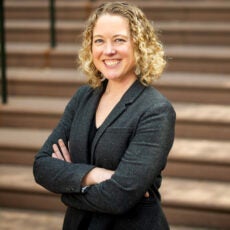
Sanya Carley
Mark Alan Hughes Faculty DirectorSanya Carley is the Faculty Director of the Kleinman Center. She is also Vice Provost for Climate Science, Policy, and Action at Penn and Presidential Distinguished Professor of Energy Policy and City Planning at the Stuart Weitzman School of Design.
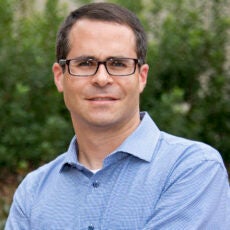
David Konisky
Associate Dean for Research, Paul H. O’Neill School of Public and Environmental Affairs at Indiana UniversityDavid Konisky is the Associate Dean for Research and a Lynton K. Caldwell Professor at the Paul H. O’Neill School of Public and Environmental Affairs at Indiana University. He also co-directs the Energy Justice Lab and serves as editor-in-chief for the journal Environmental Politics.

Andy Stone
Energy Policy Now Host and ProducerAndy Stone is producer and host of Energy Policy Now, the Kleinman Center’s podcast series. He previously worked in business planning with PJM Interconnection and was a senior energy reporter at Forbes Magazine.